
The Complete Guide to Creating AI Stained Glass Designs That Can Actually Be Manufactured
Updated July 16th 2026: This guide explains how to use ChatGPT, Midjourney, Adobe Firefly, Google Gemini and other AI image generators to create stained glass designs that can actually be manufactured by Leadbitter Glass.
AI is changing the way people design stained glass
A few years ago, if someone wanted ideas for a stained glass window, they would probably spend hours looking through magazines, browsing Pinterest, or saving photographs from websites. Today, things are very different.
Every week, we receive enquiries from customers who have created their own stained glass designs using artificial intelligence. Sometimes it’s for a new front door, sometimes a bathroom window, a feature landing window or even a complete set of decorative glazing for a renovation project.
AI has made it possible for anyone to explore ideas that they may never have considered before. Within a few minutes you can experiment with different colours, styles and patterns, ask for changes, generate several versions and gradually refine the design until you find one you really like.
For homeowners, it’s an excellent way of visualising an idea before spending money on bespoke glass.
For interior designers and architects, it’s a quick way of presenting concepts to clients.
For us at Leadbitter Glass, it often provides a fantastic starting point for a conversation.
However, there is one important thing to understand before you start generating images.
Artificial intelligence creates artwork that looks like stained glass.
It doesn’t understand how stained glass is actually manufactured.
That’s why so many AI-generated designs contain details that simply aren’t practical to produce.
The encouraging news is that this is usually easy to avoid. A few carefully chosen words in your prompt can completely change the quality of the designs AI creates.
By the end of this guide, you’ll know exactly what to ask for, what to avoid, and how to generate designs that are much closer to something that can be manufactured.
How our Overlay Stained Glass is made
Before talking about AI prompts, it’s worth understanding how our stained glass technique is produced.
At Leadbitter Glass, we create bespoke overlay stained glass, a modern process that achieves the appearance of traditional leaded stained glass while offering all the advantages of contemporary glazing.
Instead of assembling hundreds of separate thin pieces of coloured glass, we apply precision lead strips and specialist coloured overlay films directly onto toughened safety glass. This creates a beautiful stained glass effect while producing a durable panel suitable for modern homes and commercial buildings.
Our stained glass can be manufactured as:
- Toughened safety glass
- Laminated safety glass where required
- Single glazed panels
- Double glazed sealed units
- Replacement glass for existing windows and doors
This means you don’t have to compromise between appearance and practicality. You can enjoy the character of stained glass while benefiting from modern safety standards and excellent durability.
Understanding this process also explains why some AI-generated images work much better than others.
Why so many AI stained glass designs can’t be made
One of the questions we’re often asked is:
“Can you make this exactly as the AI has drawn it?”
Sometimes the answer is yes.
More often, the answer is “almost.”
That’s because AI isn’t designing a glass panel—it’s creating an illustration. It doesn’t know that our narrowest lead strip is 4.5mm wide, or that colour changes need to be clearly defined. It simply creates an attractive image based on millions of examples it has learned from.
Some of the most common issues we see include:
- Hairline lead strips that are far too thin to manufacture.
- Soft gradients where one colour blends into another.
- Realistic shadows painted into coloured areas.
- Tiny decorative details that would be lost in the finished glass.
- Intricate patterns made up of hundreds of very small sections.
- Colour changes that aren’t separated by lead lines.
None of these mean your design is a bad idea.
In fact, many of the AI concepts we receive are beautifully composed. They simply need a little practical refinement before they can become a real glass panel.
That’s where experience makes all the difference.
Our job isn’t to redesign your idea. It’s to preserve the overall appearance while making the small adjustments needed to ensure the finished panel is attractive, durable and practical to manufacture.
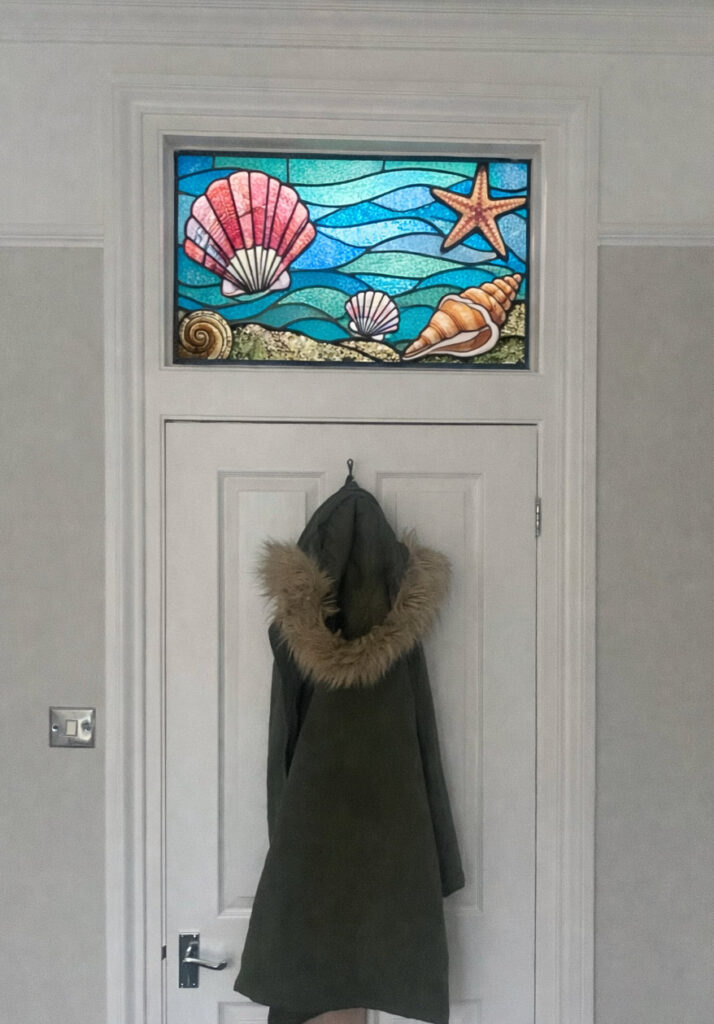
The Ai generated image above looks amazing but it isn’t a realistic example of how a finished panel would look. The shading of the shells and starfish are not possible using most techniques.
Why AI gets stained glass wrong
If you’ve ever looked closely at an AI-generated stained glass design and wondered why it seems so convincing at first glance, you’re not alone.
Modern AI image generators are incredibly clever, but they’re also a little misleading.
They haven’t learned how stained glass is manufactured. They’ve simply analysed millions of images and learned what stained glass usually looks like.
That’s an important difference.
When you ask AI to create a stained glass window, it isn’t thinking about lead strips, glass textures or manufacturing methods unless you tell it to. It’s predicting what image is most likely to satisfy your request based on everything it has seen before.
Imagine asking someone to paint a racing car when they’ve never actually seen one being built. They might produce a beautiful picture, but they probably wouldn’t know how the engine fits together underneath.
AI works in much the same way.
It understands the appearance of stained glass exceptionally well, but it doesn’t understand the practical limitations of making it.
That’s why it often creates effects that look wonderful on a computer screen but simply aren’t possible to reproduce using decorative overlay stained glass.
The good news is that you don’t need to become an expert in stained glass to improve your results.
You simply need to give the AI a little more guidance.
The more information you include in your prompt about how the finished panel will be manufactured, the more realistic your designs become.
Think like a glass designer, not a painter
This is probably the single biggest change you can make when creating AI stained glass designs.
Most AI software approaches stained glass as if it’s creating a painting.
A glass designer thinks very differently.
When we’re designing a decorative glass panel, we’re constantly asking practical questions.
Where will the lead lines go?
Will this shape look balanced?
Is there enough light coming through the clear textured glass?
Will the finished design still look attractive from the other side of the room?
Those are questions AI never asks itself unless you tell it to.
That’s why prompts such as:
“Create a realistic stained glass rose.”
often produce flowers full of soft shading, tiny veins and hundreds of delicate details.
Instead, ask for:
“A stylised stained glass rose with bold shapes, flat colours and realistic lead strips separating every coloured section.”
The second prompt is much more likely to produce something that can actually be manufactured.
It’s also likely to produce a cleaner, more elegant design.
Sometimes, less really is more.
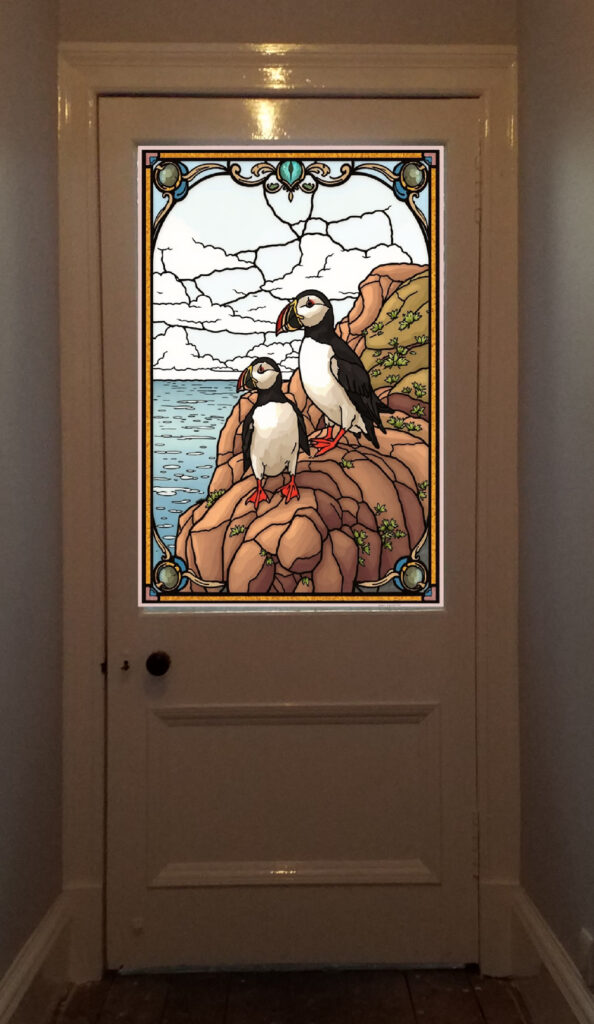
The Ai generated stained glass puffins above looks amazing but this type of design is almost impossible to replicate exactly. The shading of the Puffin chests and the tiny detail in the small green leaves are almost impossible to replicate. Ai has added very detailed lines to those leaves but the leaves don’t really offer much to the overall design. Manufacturing that amount of leaded detail in those areas would cost a lot of money for little to no benefit.
The 12 Most Common AI Stained Glass Mistakes (and How to Avoid Them)
Artificial intelligence is remarkably good at creating decorative artwork, but it’s not a stained glass designer.
Every week we see AI-generated concepts that are beautifully composed but contain small details that simply aren’t practical to manufacture. The encouraging part is that most of these problems can be avoided with a better prompt.
Here are the most common issues we come across and how you can avoid them.
1. Lead Lines That Are Too Thin
This is by far the most common problem.
AI loves drawing incredibly fine black lines between colours because they make the image look delicate and detailed.
In reality, lead strips need to have a practical width.
At Leadbitter Glass our standard lead strip widths are:
- 4.5mm
- 6mm
- 9mm
If the lead lines are thinner than this, they’ll usually need to be redesigned before the panel can be manufactured.
Try adding this to your prompt:
“Use realistic stained glass lead strips between 4.5mm and 9mm wide.”
2. Soft Colour Gradients
AI often creates colours that gently blend into one another.
For example, a flower petal may fade from deep red in the centre to pale pink at the edges.
It looks beautiful on a screen.
Unfortunately, decorative overlay stained glass doesn’t work like that.
Instead, colours should be clearly separated.
A well-designed stained glass panel relies on bold colour areas divided by lead lines rather than painted gradients.
3. Too Much Shading
This goes hand in hand with gradients.
AI likes to make flowers look three-dimensional by adding shadows and highlights.
Birds gain feathers through shading.
Leaves gain depth through painted effects.
For overlay stained glass, simpler usually looks better.
Ask the AI for:
- Flat colours
- Stylised artwork
- Decorative shapes
- No painted shading
The finished panel will often look cleaner and more elegant.
4. Tiny Decorative Details
Artificial intelligence loves detail.
The more detail it adds, the more impressive the image appears.
Tiny flower veins.
Hundreds of feathers.
Individual hairs.
Brick textures.
Wood grain.
While these look fantastic digitally, they usually don’t improve the finished stained glass panel.
Large flowing shapes almost always create a stronger design.
When writing your prompt, don’t be afraid to include phrases such as:
“Keep the design bold and simple.”
5. Too Many Individual Pieces
One thing AI often gets carried away with is breaking the design into hundreds of tiny sections.
Although overlay stained glass isn’t assembled from individual glass pieces in the same way as traditional stained glass, every lead line still needs a purpose.
A cleaner design with fewer, larger shapes generally looks more balanced and is easier to appreciate from normal viewing distance.
Remember, people rarely stand six inches away from a front door.
Most people admire it from several metres away.
6. Forgetting About the Shape of the Window
Many AI images are generated on a square canvas.
Real windows aren’t.
Before you generate your design, think about where it’s going.
Is it for:
- A tall entrance door?
- A narrow side panel?
- A fanlight above a door?
- A bathroom window?
- A landing window?
- A half-glazed internal door?
Including the window shape in your prompt often improves the overall composition dramatically. A good Ai will take your exact sizes and make the drawing to scale.
7. Using Too Many Colours
Just because AI can use every colour imaginable doesn’t mean it should.
Some of the most elegant stained glass designs use surprisingly restrained colour palettes.
For example:
- Blues with textured uncoloured glass
- Greens with amber highlights
- Soft greys with clear textured backgrounds
- Rich ruby with warm gold accents
Limiting the number of colours often creates a more timeless design.
8. Ignoring Textured Glass
One thing AI won’t automatically know is which glass textures are actually available.
At Leadbitter Glass we regularly use:
- Minster glass
- Stippolyte glass
- Clear flat glass
Including these names in your prompt encourages AI to create designs that are much closer to a real finished panel. As our glass panels are made with one solid sheet of toughened glass, the whole base glass will be one of the textures above or a plain flat glass.
9. Making Everything Perfectly Symmetrical
This might sound surprising.
While symmetry works beautifully for many entrance doors, some of the most attractive stained glass designs include gentle asymmetry.
A flowering stem that curves naturally.
A bird looking towards the centre of the panel.
Leaves flowing in slightly different directions.
Don’t be afraid to ask AI for:
“A balanced but natural composition.”
That often produces more interesting results than strict symmetry.
10. Forgetting About Natural Light
Remember that stained glass isn’t just something you look at.
It’s something light shines through.
Large areas of deep colour can reduce the amount of daylight entering a room.
By including areas of uncoloured glass, you can create a panel that remains bright while still providing colour and privacy where needed.
11. Designing for a Computer Screen Instead of a Home
AI creates artwork to look impressive at full screen on a monitor.
Real stained glass is experienced very differently.
It catches the light throughout the day.
The exterior view comes alive at night when lights are on inside the home.
It looks different in bright sunshine than it does on a cloudy afternoon.
It becomes part of the character of your home.
The best designs aren’t necessarily the most complicated.
They’re the ones that still look beautiful every time you walk through the front door.
12. Expecting AI to Produce the Finished Design
Perhaps the biggest misconception is believing that the first image AI generates will be the finished design.
Think of AI as your designer’s sketchbook.
Generate five ideas.
Then ten.
Mix elements from each one.
Ask for changes.
Refine the colours.
Adjust the composition.
Remove unnecessary detail.
The best results usually come after a conversation with the AI rather than a single prompt.
And once you’ve found a design you really like, that’s where we come in.
At Leadbitter Glass we’ll review your artwork, explain whether any practical adjustments are needed and provide a quotation to manufacture your design using our overlay stained glass process on toughened safety glass, either as a single glazed panel or a double glazed sealed unit.
How to Write AI Prompts That Produce Better Stained Glass Designs
One of the biggest misconceptions about AI image generators is that they only need a few words to create something impressive.
Technically that’s true.
The quality of the finished image is almost always determined by the quality of the prompt.
Think of AI as an artist sitting opposite you with a blank sheet of paper.
If you simply say, “Draw me a stained glass window,” you’ll receive whatever that artist imagines.
If, however, you explain the style, colours, proportions, lead widths, glass textures and the room it’s intended for, the artwork becomes far more accurate.
The more information you provide, the more useful the result.
Start by describing the window, not the artwork
Instead of beginning your prompt with the design itself, begin with the purpose of the glass.
For example:
- A Victorian front door.
- A modern composite entrance door.
- A bathroom window.
- A kitchen feature window.
- A landing window.
- An internal glazed door.
- A fanlight above a front door.
- A pair of entrance side panels.
This immediately gives the AI context and helps it produce a design with the correct proportions.
Tell the AI you’re designing overlay stained glass
Don’t assume the software understands the manufacturing process.
Actually tell it.
For example:
“Create an overlay stained glass design suitable for manufacture using realistic lead strips applied to toughened safety glass.”
Those few extra words often make a noticeable difference.
Be Specific About the Lead Lines
Lead lines define the entire design.
Without guidance, AI usually makes them far too thin.
Include instructions such as:
- Use realistic lead strips.
- Minimum lead width 4.5mm.
- Use 4.5mm, 6mm and 9mm lead strips.
- Bold decorative lead lines.
- Clean, practical construction.
You’ll usually notice the artwork immediately starts looking more believable.
Keep Colours Flat
One instruction we recommend including in almost every prompt is:
“Use flat coloured glass with no gradients, no painted shading and no soft transitions between colours.”
This encourages AI to think in coloured shapes instead of painted illustrations.
Ask for Glass That Actually Exists
Another useful addition is to specify the glass textures.
At Leadbitter Glass we regularly work with:
- Minster glass
- Stippolyte glass
- Clear flat glass
Including these names in your prompt produces concepts that are much closer to something we can manufacture. Remember that the whole window/door glass will be made with the same texture throughout so state something like “create my stained glass design using Minster as the base texture throughout”
Tell AI What Not to Do
Many people focus entirely on what they want.
Sometimes it’s equally helpful to explain what you don’t want.
For example:
- No gradients.
- No painted effects.
- No photographic detail.
- No hairline lead strips.
- No tiny decorative sections.
- No realistic shadows.
- No airbrushed colours.
Think of it as giving the AI a few sensible boundaries.
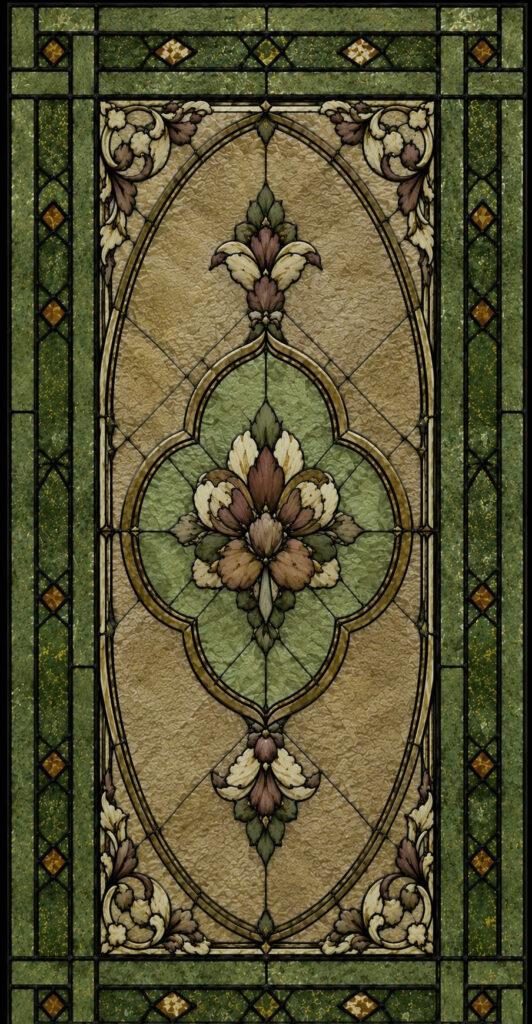
The Ai stained glass design above is a perfect example of what cannot be made in reality. The colours, the leaded lines, the textures, the shading and the amount of fine detail make this design a total non starter. The Ai program made this image look more like a bedroom duvet cover or a carpet rug than a piece of glass. This example proves that a good ai prompt is very important.
Describe the Style
Now comes the creative part.
This is where you explain the overall look you’re trying to achieve.
Some popular styles include:
- Contemporary geometric
- Art Nouveau
- Arts and Crafts
- Mackintosh inspired
- Floral
- Wildlife
- Coastal
- Celtic
- Abstract
- Art Deco
- Minimalist
If you already have a particular colour scheme in your home, include that as well.
Finish With How the Design Will Be Used
Finally, explain where the glass will be installed.
For example:
“Suitable for a south-facing front door.”
or
“Designed to maximise privacy while allowing plenty of natural light.”
or
“Suitable for manufacture as a double glazed sealed unit.”
These details often help the AI make more sensible design decisions.
A Simple Prompt Formula That Works
Rather than starting from scratch every time, we’ve found it’s much easier to follow the same basic structure.
Think of your prompt as six simple steps:
1. What is it for?
Front door, bathroom window, side panel, internal door or feature glazing.
2. What style do you want?
Art Nouveau, geometric, floral, wildlife, Mackintosh, coastal or contemporary.
3. Which colours would you like?
Keep the palette fairly simple for the most elegant results.
4. Which glass textures should be used?
Minster glass, Stippolyte glass or clear flat glass.
5. How should it be manufactured?
Overlay stained glass using realistic 4.5mm, 6mm and 9mm lead strips on toughened safety glass.
6. What should the AI avoid?
No gradients, no painted shading, no hairline lead strips and no tiny decorative details.
By following this simple formula you’ll usually achieve much better results than using a short one-line prompt.
A Final Tip Before You Press Generate
Don’t expect perfection from the first image.
Professional designers rarely get everything right on the first attempt, and AI is no different.
Generate several versions.
Take the parts you like from each.
Ask the AI to make small changes.
Try different colour combinations.
Experiment with different styles.
Sometimes the fifth or sixth version is dramatically better than the first.
And remember, once you’ve created a design you’re happy with, you don’t have to worry about whether it’s completely suitable for manufacture.
That’s where we can help.
Send your favourite design to Leadbitter Glass, and we’ll review it, explain whether any practical adjustments are needed and provide a no-obligation quotation to manufacture your bespoke overlay stained glass panel.
Which AI Image Generator Is Best for Stained Glass Designs?
One of the questions we’re starting to hear more often is:
“Which AI image generator should I use for stained glass designs?”
The honest answer is that there’s no single winner.
Each AI image generator has its own strengths, and each creates decorative artwork in a slightly different way. Some are better at following detailed instructions, while others produce more artistic or imaginative results.
The good news is that they’re all capable of creating beautiful stained glass concepts, especially when you provide clear prompts and explain that the design needs to be suitable for manufacture.
Here’s our experience of the most popular AI image generators.
ChatGPT Image
If you’re completely new to AI, ChatGPT is probably the easiest place to start.
One of its biggest advantages is that you’re having a conversation rather than typing a single prompt.
If the first image isn’t quite right, you can simply ask for changes.
This makes refining a design much easier than starting again from scratch.
It’s particularly good if you’re still developing your ideas and want to experiment with different styles before deciding on a final design.
Midjourney
Midjourney has earned a reputation for producing some of the most beautiful AI artwork available.
Its stained glass images are often rich in colour and full of creative ideas.
However, it does have a habit of creating very intricate lead patterns, soft gradients and decorative details that may need simplifying before manufacture.
Think of Midjourney as a fantastic source of inspiration rather than a technical drawing tool.
If you’re looking for artistic concepts, it’s an excellent choice.
Adobe Firefly
Adobe Firefly is particularly popular with graphic designers and creative professionals.
Its compositions are often clean and balanced, making it well suited to decorative glass projects.
If you’re already using Adobe Photoshop or Illustrator, Firefly fits naturally into that workflow.
We often find Firefly produces elegant contemporary designs that only need minor adjustments before they’re ready for manufacture.
Google Gemini
Google Gemini continues to improve and is very capable of generating decorative stained glass concepts.
It’s especially useful if you enjoy experimenting with different artistic styles or asking follow-up questions about your design.
Like all AI image generators, it’s worth reminding Gemini that the design should use realistic lead widths, flat colours and practical construction.
Ideogram
Ideogram has become increasingly popular because of its decorative artwork and ability to create clean, modern compositions.
It works particularly well for geometric designs, abstract patterns and contemporary decorative glass.
If you’re looking for a modern entrance door design with bold lead lines and strong shapes, it’s definitely worth trying.
Which One Do We Recommend?
People often expect us to recommend one particular AI image generator.
In reality, we’d encourage you to try several.
The same prompt entered into different AI software can produce completely different results.
You might prefer the colours from one image, the composition from another and the floral details from a third.
Don’t feel you have to choose just one.
Some of the best stained glass concepts we’ve seen have been created by combining ideas from several different AI images before producing a final version.
Remember, AI is there to help you explore possibilities.
Once you’ve found a design you really like, we’ll help turn it into a beautiful piece of bespoke overlay stained glass that’s suitable for manufacture using toughened safety glass, either as a single glazed panel or a double glazed sealed unit.
Finding Inspiration for Your AI Stained Glass Design
One of the best things about using AI is that you’re not limited to existing stained glass designs. Instead of browsing hundreds of photographs looking for something similar to your home, you can create something completely unique.
If you’re not sure where to start, think about the style of your property, the amount of privacy you need, and the atmosphere you’d like to create.
Some people prefer clean, contemporary designs with simple geometric shapes, while others love traditional floral patterns inspired by nature. Neither approach is right or wrong; the best design is the one that feels at home in your property.
Here are some ideas that consistently work well for decorative overlay stained glass.
Front Door Stained Glass
The front door is often the first thing visitors notice, making it one of the most popular places to introduce decorative glass.
Whether your home is a Victorian terrace, an Edwardian semi, a 1930s property or a modern new build, AI can help you visualise a design that complements the architecture.
Popular ideas include:
- Flowing Art Nouveau flowers
- Contemporary geometric patterns
- Mackintosh-inspired roses
- Elegant bevel-style effects
- Curved lead work with subtle coloured highlights
- Frosted-style backgrounds combined with coloured feature panels
When designing a front door, remember that the panel should look attractive both from outside your home and from inside your hallway.
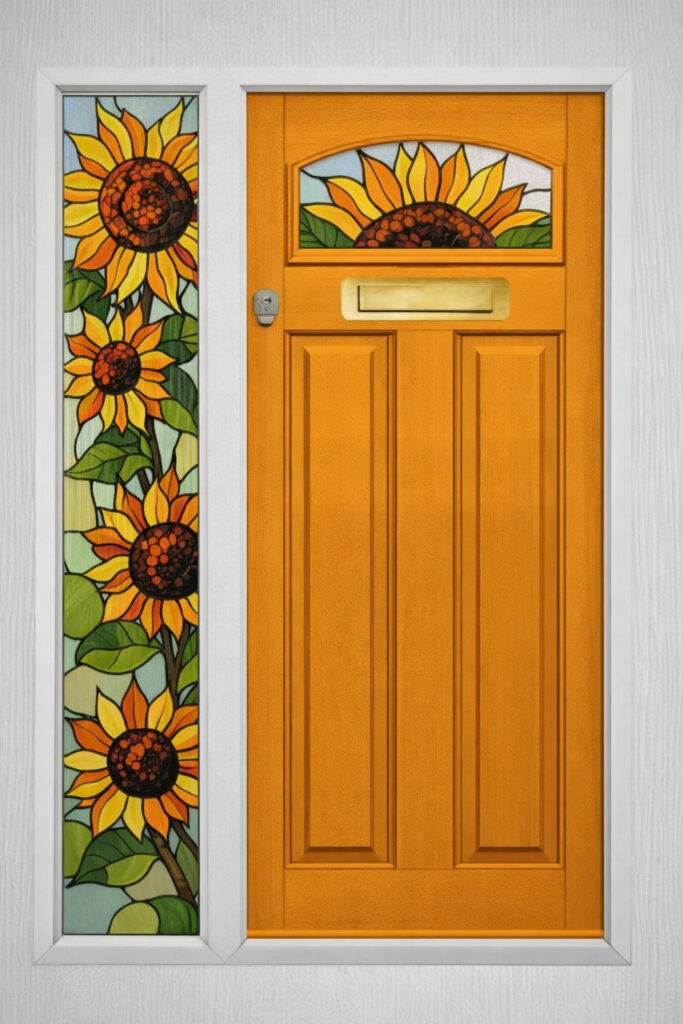
The above Ai image of Sunflowers is quite a good image generation. Most of the lines can be created using lead strips. One of the only alterations we would recommend is having less of the small circles in the brown sunflower centre. The lead strip used for those sections would be 4.5mm wide so with dozens of circles all crammed together, there wouldn’t be much room left in that area to show off the colour.
Side Panels
Entrance side panels are ideal for adding extra colour and character while still allowing plenty of natural light into your hallway.
Many customers choose a matching design that continues seamlessly from the main door panel, while others prefer complementary patterns that frame the entrance without being identical.
Side panels also work particularly well with Minster glass or Stippolyte glass to provide additional privacy.
Bathroom Windows
Bathrooms are one of the easiest rooms to design for because privacy is usually the main priority.
Rather than relying on plain obscure glass, AI can create decorative botanical designs, flowing reeds, flowers, dragonflies or abstract patterns that provide privacy while allowing plenty of daylight into the room.
Because the light changes throughout the day, simple designs with carefully chosen colours often create the most attractive effect.
Kitchen Windows
Kitchen windows often benefit from lighter, brighter designs.
Fruit, herbs, wildflowers, vines, contemporary geometric patterns and coastal themes are all popular choices.
Try to avoid making the design too dense with colour, as kitchens generally benefit from as much natural light as possible.
Landing Windows
Landing windows are often overlooked, but they can become one of the most striking decorative features in a home.
Because these windows are usually viewed from both upstairs and downstairs, balanced designs tend to work particularly well.
Circular motifs, flowing floral arrangements and elegant geometric patterns all create beautiful focal points.
Internal Doors
Decorative glass isn’t just for external windows and doors.
Overlay stained glass can also be used in internal glazed doors to separate rooms while allowing light to pass through.
Popular designs include:
- Contemporary geometric layouts
- Art Deco influences
- Simple frosted-style effects with coloured highlights
- Minimalist linear patterns
Wildlife Designs
Nature has always been a popular source of inspiration for stained glass, and AI is particularly good at generating wildlife themes.
Some favourites include:
- Robins
- Kingfishers
- Barn owls
- Blue tits
- Dragonflies
- Butterflies
- Bees
- Swallows
- Woodland scenes
When creating wildlife designs, it’s often worth asking the AI to keep the details stylised rather than photographic.
Simple shapes generally translate much better into decorative glass.
Floral Designs
Flowers remain one of the most requested themes for stained glass, and it’s easy to see why.
They work in both traditional and modern homes, offering endless opportunities to experiment with colour.
Popular choices include:
- Roses
- Lilies
- Irises
- Poppies
- Tulips
- Daisies
- Wildflowers
- Lavender
- Sunflowers
- Cherry blossom
One useful tip is to ask the AI for “stylised floral stained glass” rather than “realistic flowers.” The results are usually cleaner and more suitable for manufacture.
Geometric Designs
If your home has a contemporary feel, geometric stained glass can create a striking modern look.
Squares, rectangles, circles and sweeping diagonal lines often produce elegant panels that never go out of fashion.
Geometric designs also tend to work particularly well with clear flat glass and subtle coloured accents.
Coastal and Nature Themes
Homes near the coast often suit designs inspired by the local landscape.
Ideas include:
- Waves
- Sailing boats
- Seashells
- Lighthouses
- Sand dunes
- Sea grasses
- Seagulls
- Dolphins
These themes can be as subtle or as colourful as you like.
Abstract Designs
Sometimes the most effective stained glass contains no recognisable objects at all.
Abstract designs allow colour, texture and lead work to become the main focus.
They are especially popular in contemporary homes where clean lines and simplicity are important.
Let Your Imagination Take Over
One of the biggest advantages of AI is that it allows you to explore ideas without committing to a final design.
You might begin with an Art Nouveau flower, then ask the AI to make it more contemporary.
Or you may combine the colours from one design with the layout of another.
Don’t be afraid to experiment.
Some of the most beautiful stained glass panels we’ve produced started as a completely different idea before evolving through several versions.
The more you refine your design, the closer you’ll get to creating something that’s truly unique to your home.
Before You Send Your AI Design to Leadbitter Glass
Creating an AI stained glass design is exciting, and it’s very easy to keep generating new ideas. Before you send us your favourite design for a quotation, it’s worth spending a few minutes looking at it with a slightly more critical eye.
You don’t need to be a stained glass expert, but asking yourself a few simple questions can save time and help you achieve an even better finished result.
Does the Design Look Good From a Distance?
AI images are usually viewed full-screen on a computer or phone.
Real stained glass isn’t.
Most people admire a front door from the garden path, notice a bathroom window from across the room, or catch a glimpse of a landing window while walking up the stairs.
Try shrinking your AI image down so it’s only a few inches wide on your screen.
Can you still clearly see the main design?
If the important details disappear, it may be worth simplifying the layout.
Some of the most striking stained glass panels rely on bold shapes rather than tiny details.
Is There Enough Natural Light?
Decorative glass should enhance your home, not make it feel darker.
Large areas of strong colour can reduce the amount of daylight entering a room, particularly in hallways and bathrooms where natural light may already be limited.
A well-balanced design usually combines coloured sections with clear or textured glass, allowing light to flow through while still providing privacy and decoration.
Does Every Lead Line Have a Purpose?
One of the easiest ways to improve an AI design is to look at the lead work.
Ask yourself:
“Why is that lead line there?”
If it helps define a flower, a leaf or a geometric shape, it probably belongs.
If it seems to wander randomly through the design without adding anything, it may simply be visual clutter.
Good stained glass designs tend to have lead lines that guide your eye around the panel rather than distracting from it.
The more lead lines you add, the less room is available for colour and light.
Would You Still Like It in Ten Years?
Trends come and go.
Stained glass usually stays.
Because decorative glass is a long-term feature of your home, it’s worth choosing a design that you’ll still enjoy years from now.
Classic floral patterns, elegant geometric layouts and balanced abstract designs tend to age particularly well.
If you’re unsure, generate several different versions and compare them over a few days rather than making an immediate decision.
Don’t Chase Perfection
One of the biggest advantages of AI is that you can always make another version.
One of the biggest disadvantages is… you can always make another version.
It’s surprisingly easy to spend hours making tiny changes and never feel completely finished.
At some point, it’s worth choosing the design that makes you smile every time you look at it.
Remember, your AI image doesn’t need to become a manufacturing drawing.
It simply needs to communicate your idea.
We’ll help with the practical details.
What Happens When You Send Us Your Design?
Once you’ve chosen your favourite AI design, simply send it to us by email along with the approximate glass sizes or a photograph of the existing window or door if you’re unsure of the dimensions.
We’ll carefully review the design and let you know whether any practical adjustments are recommended before manufacture.
In many cases, the changes are surprisingly small.
A lead line may need moving slightly.
A tiny decorative detail might need simplifying.
A colour transition may need defining more clearly.
Our aim is never to change the character of your design.
Instead, we make the subtle refinements needed to ensure the finished panel is attractive, practical and suitable for manufacture.
Once everything has been agreed, we’ll provide a no-obligation quotation to manufacture your bespoke overlay stained glass.
Depending on your project, we can produce your panel as:
- Toughened safety glass
- Toughened laminated safety glass where required
- Single glazed panels
- Double glazed sealed units
Whether it’s a single front door panel or decorative glazing throughout your home, we’ll help turn your AI concept into something you’ll enjoy for many years to come. We create a realistic scale drawing of your preferred design for approval with every order placed. We only make the actual glass once you tell us the layout is ‘perfect’
Why Choose Leadbitter Glass?
We know there are plenty of companies offering decorative glass, so why choose us?
Quite simply, because we understand both sides of the process.
We appreciate the creativity that AI makes possible, but we also understand the practical considerations involved in manufacturing decorative overlay stained glass.
Rather than simply saying “that can’t be done”, we’ll explain why, suggest practical alternatives where necessary, and do everything we can to preserve the original look and feel of your chosen design.
Our aim is to make the journey from AI concept to finished glass panel as straightforward and enjoyable as possible.
10 AI Stained Glass Prompts You Can Copy and Paste
If you’ve never used an AI image generator before, don’t worry about writing the perfect prompt from scratch. One of the easiest ways to learn is by starting with a well-written prompt and then adapting it to suit your own ideas.
The prompts below have all been written with decorative overlay stained glass in mind. They encourage AI to create designs that are much closer to something that can be manufactured rather than simply producing attractive digital artwork.
Feel free to copy, paste and modify these prompts as much as you like. Change the colours, replace the flowers with birds, make the design more contemporary or ask the AI to simplify the layout. The more you experiment, the better your results are likely to become.
Remember, it’s all about the prompt!
Prompt 1 – Elegant Contemporary Front Door
Create a contemporary overlay stained glass design for a modern front door. Use bold geometric shapes with a balanced and uncluttered composition. Separate every coloured section using realistic lead strips measuring approximately 6mm wide. Use flat colours only with no gradients, painted shading or photographic effects. Use Minster glass, Stippolyte glass or clear flat as the whole base glass to maximise natural light. The design should look elegant, practical and suitable for manufacture using toughened safety glass.
Prompt 2 – Art Nouveau Entrance Panel
Design an elegant Art Nouveau overlay stained glass panel featuring flowing lilies, curved stems and graceful organic lead lines. Use a symmetrical layout suitable for a front door. Every colour change should be separated by realistic lead strips 6mm wide. Use flat coloured glass with no gradients or painted shadows. Incorporate Minster textured glass for the background with carefully positioned coloured highlights. Suitable for manufacture on toughened safety glass.
Prompt 3 – Bathroom Privacy Window
Create a decorative bathroom overlay stained glass design inspired by reeds, dragonflies and flowing grasses. Use Minster glass or Stippolyte glass to provide privacy while allowing plenty of natural light. Keep the coloured areas simple and bold with realistic lead strips measuring 4.5mm, 6mm and 9mm. Avoid tiny details, gradients and painted effects. Suitable for manufacture using toughened safety glass.
Prompt 4 – Mackintosh Inspired Design
Create an overlay stained glass design inspired by the work of Charles Rennie Mackintosh using stylised roses, elegant vertical lines and simple geometric shapes. Use realistic lead strips with a width of 6mm. Flat coloured glass only. No gradients, painted shading or overly intricate details.
Prompt 5 – Wildlife Window
Design an overlay stained glass panel featuring a kingfisher perched on reeds beside a river. Keep the artwork stylised rather than photographic. Use bold areas of flat colour separated by realistic lead strips measuring between 4.5mm and 9mm. Include textured Minster glass as the whole base glass and avoid tiny feather details or painted shading. Suitable for manufacture on toughened safety glass.
Prompt 6 – Floral Feature Panel
Create a decorative floral overlay stained glass panel featuring poppies, daisies and wildflowers arranged in a balanced composition. Use rich reds, warm ambers and soft greens with realistic lead strips measuring 6mm wide. Use flat coloured glass with no gradients and use either Minster glass or Stippolyte glass as the background. Suitable for manufacture as a toughened safety glass panel.
Prompt 7 – Art Deco Design
Create an elegant Art Deco overlay stained glass design featuring stepped geometric shapes, sweeping curves and bold symmetrical lines. Use a restrained colour palette of black, amber, pale blue and clear glass. All coloured sections should be separated by realistic lead strips measuring 6mm wide No gradients or painted effects. Suitable for manufacture using toughened safety glass.
Prompt 8 – Coastal Theme
Design a decorative overlay stained glass panel inspired by the British coastline. Include stylised waves, sea grasses and a lighthouse in the distance. Keep the composition clean and uncluttered with realistic lead strips, flat coloured glass and textured Stippolyte glass. Avoid photographic detail, gradients and tiny decorative elements. Suitable for manufacture using toughened safety glass.
Prompt 9 – Geometric Side Panel
Create a contemporary geometric overlay stained glass design for a narrow entrance side panel. Use rectangles, circles and diagonal lead lines with realistic lead strip widths between 4.5mm and 9mm. Incorporate either Minster glass or Stippolyte glass or clear flat glass as the base glass. No gradients or painted shading. Suitable for manufacture using toughened safety glass.
Prompt 10 – Minimalist Decorative Glass
Create a minimalist overlay stained glass design using elegant sweeping lead lines of 6mm wide, subtle colour accents and generous areas of textured clear glass. Keep the design light, modern and uncluttered. Use flat coloured glass with clear sections only with no gradients or painted effects. Suitable for manufacture as either a single glazed toughened safety glass panel or a double glazed sealed unit.
A Few Final Tips Before You Generate Your Design
Even the best prompt won’t always produce the perfect result on the first attempt. AI image generators are designed to be interactive, so don’t be afraid to refine your request.
If the lead lines look too thin, ask the AI to make them bolder.
If the design feels too busy, ask it to simplify the composition.
If there’s too much colour, request larger areas of Minster glass, Stippolyte glass or clear flat glass to brighten the panel.
Small changes to your wording can make a remarkable difference to the finished design, so keep experimenting until you create something you genuinely love.
What Happens After You Send Us Your AI Design?
One of the questions we’re asked most often is whether we can manufacture an AI-generated stained glass design exactly as it appears on screen.
The honest answer is that every design is different.
Some AI-generated designs are surprisingly practical and need very little alteration before they can be manufactured. Others contain artistic effects that look beautiful digitally but aren’t suitable for decorative overlay stained glass.
The important thing is that you don’t need to worry about identifying these differences yourself.
That’s our job.
When you send your design to Leadbitter Glass, we’ll carefully assess every aspect of the artwork and explain whether any practical refinements would improve the finished panel.
In many cases, those refinements are extremely small.
Perhaps a lead line needs moving slightly to create a stronger shape.
Maybe a tiny decorative detail needs simplifying.
Occasionally, a colour transition needs defining more clearly so it can be reproduced using coloured overlay films.
Our aim is always the same: to preserve the character and appearance of your original design while making sure the finished glass is practical to manufacture and looks every bit as impressive in your home as it did on your computer screen.
We Don’t Expect You to Get Everything Right
Some customers hesitate before sending us their AI designs because they think they need to create the perfect image first.
Please don’t worry about that.
AI is a creative tool, not a technical drawing package.
We’re much happier receiving an image that captures your ideas than a design you’ve spent hours trying to perfect.
Even if you’ve generated ten different versions, send them all.
Sometimes the best solution comes from combining elements from several different designs.
You might love the flowers from one image, the colours from another and the lead pattern from a third.
By seeing the designs you like, we gain a much better understanding of the finished look you’re hoping to achieve.
What Information Should You Send?
To help us provide an accurate quotation, it’s useful to include:
- Your AI-generated image or images
- Approximate glass dimensions
- Whether the panel is for a door, window or side panel
- Whether you require single glazed or double glazed glass
- Any particular colours or design features that are especially important to you
If you’re unsure about measurements, don’t worry.
A quick photograph of your existing window or door is often enough for us to advise you on the next steps.
Every Design Is Bespoke
One of the biggest advantages of using AI is that your design doesn’t have to look like anybody else’s.
You’re not choosing from a catalogue.
You’re creating something that’s unique to your property.
Whether it’s a contemporary geometric entrance door, a Mackintosh-inspired bathroom window, a wildlife panel for a landing or a colourful floral design for your kitchen, we’ll manufacture your decorative overlay stained glass to your individual requirements.
That’s one of the reasons AI and bespoke glass work so well together.
One provides unlimited creative possibilities.
The other turns those ideas into a finished product that’s made specifically for your home.
Ready to Turn Your AI Design Into Reality?
If you’ve created an AI stained glass design that you’d love to see in your home, we’d be delighted to help.
Simply send us your favourite design along with the approximate glass size or a photograph of your existing window or door.
We’ll review the artwork, explain whether any practical adjustments are recommended and provide a free, no-obligation quotation.
All of our decorative overlay stained glass is manufactured using toughened safety glass and can be supplied as either single glazed panels or double glazed sealed units, depending on your requirements.
Whether your design is modern, traditional in appearance, floral, geometric or completely unique, we’ll help transform your AI concept into a beautiful finished piece of decorative glass.
Save Time and Money by Asking AI for a Line Drawing
Once you’ve created an AI stained glass design that you’re happy with, there’s one extra step that can save time and money during the production process.
Instead of only downloading the finished coloured image, ask the AI image generator to create a second version showing exactly the same design as a clean black and white thin line drawing.
The drawing should contain only the lead layout, with no colours, shading, textures or background detail. Ask for the lines to be really thin.
A high-resolution version of this outline can often be used as the starting point for our drawing software, making it much quicker to recreate the design accurately.
While every project still needs checking and may require adjustments, a well-produced line drawing can significantly reduce the amount of manual tracing needed before manufacture begins.
This can help reduce artwork preparation time and, in some cases, lower drawing costs.
A prompt such as the following often works well:
“Using exactly the same stained glass design, create a high-resolution black and white vector-style line drawing showing only the lead lines as thin lines. Remove all colours, textures, shading and backgrounds. Use clean continuous black lines on a plain white background with no perspective, suitable for tracing into CAD or drawing software.”
If the AI doesn’t quite get it right first time, don’t worry. Simply ask it to make the lines cleaner, remove any unnecessary details or increase the image resolution. You can even ask it to produce an SVG-style or technical outline if the software supports it.
When you send your enquiry to Leadbitter Glass, include both the full-colour version and the black and white outline. Having both versions gives us a much better starting point and helps us assess the design more efficiently.
Frequently Asked Questions About AI Stained Glass Designs
Can artificial intelligence really create stained glass designs?
Yes. Modern AI image generators are remarkably good at producing decorative concepts. They’re an excellent way to explore ideas, colour combinations and styles before committing to a final design. The important thing to remember is that AI creates artwork rather than manufacturing drawings, so some refinement is often needed before a design is suitable for production.
Do I need any design experience?
Not at all.
One of the biggest advantages of AI is that anyone can start creating ideas within minutes. Even if you’ve never designed anything before, a good prompt can produce impressive results. As your confidence grows, you can gradually refine your prompts to create something more personal and unique.
Which AI image generator should I choose?
There are several excellent options available, including ChatGPT, Midjourney, Adobe Firefly, Google Gemini and Ideogram.
Each has its own strengths, so it’s worth experimenting with more than one. Many customers find that using the same prompt in different AI tools produces completely different interpretations of the same idea.
Can I upload a photograph of my house?
Yes.
Most modern AI image generators allow you to upload reference photographs. This can be a great way of visualising how a decorative glass design might suit your entrance door, bathroom window or another area of your home.
Why do AI images sometimes look impossible to manufacture?
AI has been trained to create attractive artwork rather than practical decorative glass.
It doesn’t automatically understand things such as realistic lead widths, available glass textures or the limitations of coloured overlay films. That’s why adding the right instructions to your prompt makes such a difference.
What is the biggest mistake people make?
Trying to include too much detail.
The most successful decorative glass designs are often the simplest. Bold shapes, clean lead lines and carefully chosen colours usually produce a stronger finished panel than hundreds of tiny decorative elements.
Can I ask AI to simplify an existing design?
Absolutely.
In fact, this is one of the best uses of AI.
You can ask it to remove unnecessary details, reduce the number of colours, enlarge individual sections or make the overall composition cleaner and more balanced.
Should my design be perfectly symmetrical?
Not necessarily.
Symmetry works well for many entrance doors, but natural-looking floral and wildlife designs often benefit from gentle asymmetry. The most important thing is that the composition feels balanced when viewed as a whole.
Can Leadbitter Glass manufacture every AI design?
Not every design exactly as generated, but the vast majority can either be manufactured or adapted with relatively small changes.
If any alterations are recommended, we’ll always explain why and aim to keep your original concept intact.
What happens after I send my design?
We’ll review the artwork, discuss any practical refinements that may improve the finished result and prepare a free, no-obligation quotation based on your requirements.
Can I request a line drawing from AI?
Yes, and we strongly recommend it.
Once you’ve generated your preferred design, ask the AI to create a matching black and white line drawing showing only the lead layout. This can often provide an excellent starting point for our drawing software, reducing the amount of manual tracing required and potentially lowering artwork preparation costs.
Can I combine several AI designs into one?
Definitely.
Many of the best projects begin with ideas taken from several different images. You might prefer the colours from one design, the flowers from another and the lead pattern from a third. AI makes it easy to combine these ideas into a single concept.
What glass textures are available?
For decorative overlay stained glass we commonly use Minster glass, Stippolyte glass or clear flat glass. Including one of these base glass these materials in your AI prompts often produces more realistic and practical concepts.
Can decorative overlay stained glass be double glazed?
Yes.
Many of our designs are manufactured within modern double glazed sealed units, making them suitable for replacement windows and entrance doors.
Is toughened safety glass available?
Yes.
Our decorative glass is manufactured using toughened safety glass as standard, providing the strength and durability expected in modern homes.
How do I request a quotation?
Simply send us:
- Your AI-generated design
- A line drawing if you’ve created one
- Approximate dimensions
- A photograph if available
- Whether it’s for a door or window
- Any colours or features that are particularly important to you
We’ll then review everything and prepare your quotation.